
Why Decodable Books Matter and How Libraries Are Making It Easier for Families to Support Early Reading
Updated: Sep 9, 2025

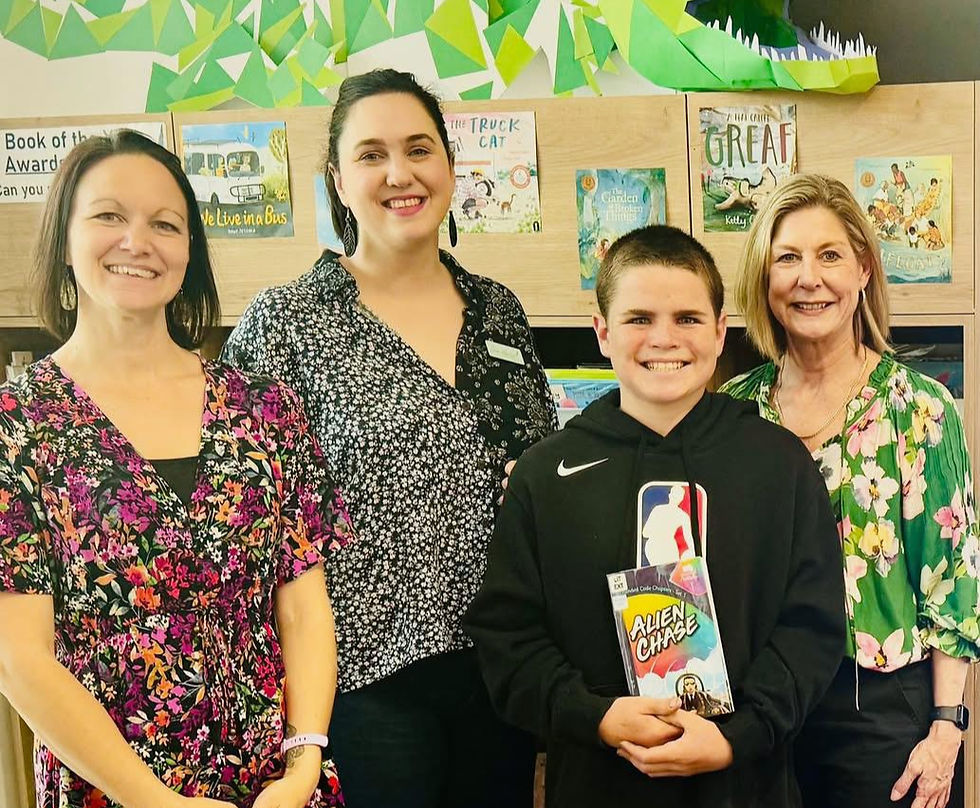
Available for local families to borrow and use, the Port Macquarie Library has launched a new extensive collection of decodable readers. These are books specifically designed to support children who are learning to read using structured phonics-based instruction.
As a literacy specialist working with students across the Port Macquarie-Hastings region, I’m often asked:
What exactly is a decodable book, and why are they so important?
To answer that, it helps to understand something interesting about reading: it is not a natural skill, but rather something that must be taught.
Why Reading Needs to Be Taught
Humans have been speaking for over 100,000 years. Oral language is biologically wired and children learn to speak by being immersed in language. But reading is quite different.
Reading and writing are culturally recent skills in human history. The printing press was invented in mid 15th century Europe, which greatly expanded access to text, but widespread literacy in English grew gradually over the next several centuries.
That’s how recent reading is in the context of human history and why it’s something that must be taught, not assumed. That is where decodable books come in.
What Is a Decodable Book?
A decodable book is written to include only the letter sound relationships (or ‘code’) that a child has already been explicitly taught. That means the child can read it by sounding out words based on what they know.
For example, if a child has only learned the sounds for s, a, t and p, they can confidently read a sentence like “Pat sat.” This is part of what’s known as a structured, cumulative and explicit phonics sequence, starting with the simplest sounds and gradually building to more complex patterns.
There are two broad stages of phonics instruction: Initial code refers to simple, consistent sound–letter matches such as m, a, t. Extended code includes more complex patterns like vowel teams such as ea in team, or oa in boat and alternative spellings.
High-frequency ‘tricky’ words that don’t follow regular patterns, like said or one, are still part of the plan. These should be taught clearly and one at a time. Only around 4 to 6 percent of English words are truly irregular. That means most words can be decoded if the code is taught well, particularly when children receive further instruction in morphology (the parts of words) and their eptymology (history). Children don’t need to memorise hundreds of exceptions.
Why Decodables Are Essential, Not Just Helpful
Decodable books benefit all early readers. For students with reading difficulties or specific learning disorders, they are essential. Children with dyslexia, for example, require instruction that is clear, sequenced and repeated.
Decodables provide exactly that kind of practice.This practice assists in a process called ‘orthographic mapping’. This is the mental process that enables readers to connect the sounds of a word (phonemes) with its written form (graphemes) creating a permanent, easily retrievable memory of the word.

For older students who have reading gaps, catch-up decodable readers follow the same structured phonics pathway but use age-appropriate vocabulary and themes. These books meet students where they’re at, helping them build skills in a way that supports their confidence and respects their interests.
Building Fluency Through Practice
One of the biggest misconceptions about reading is that fluency comes from giving children harder books. In reality, fluency—reading with accuracy, confidence and expression—comes from more practice with the right kind of text.
Repeated reading of decodable texts helps children move from slow, effortful decoding to fluent, expressive reading. They are a stepping stone to authentic texts. Rereading helps create the necessary neural pathways in the brain to unlock the reading code creating accuracy and automaticity.
Research supports this approach. The National Reading Panel (2000), along with more recent work by Australian researchers including Professor Pamela Snow and Dr Jennifer Buckingham, shows that guided, repeated reading of texts that match a child’s phonics knowledge leads to measurable gains in fluency, accuracy and understanding.
How This Library Collection Helps
What makes this new decodable collection at the library so valuable is that it has already been thoughtfully organised into clear, sequenced packs.
Families don’t have to guess where to start. If your child is working on sounds like sh, ch or th, you can borrow a pack that contains words following this developmental sequence. Later, as they progress to more advanced code such as vowel teams or longer words, the next level is ready to go.
For older students, the same principle applies. Parents are encouraged to match the books to their child’s current skill level, not age or year group. If you're unsure where to begin, you can ask a teacher, tutor, librarian or connect with SPELD NSW’s parent hotline for guidance.
A Final Word for Families
Use the packs. Re-read the books. Support decoding first. And most importantly, know that you’re not alone. There is a growing community of educators, librarians and specialists working together to make learning to read more accessible, effective and empowering for every child.
Whether your child is starting school, catching up or needs extra support, this collection is a practical and powerful resource to help them thrive.
Acknowledgements
A special thank you to the Port Macquarie Library team, Penny Evans and Lindsey Fletcher; Kelly King and the wonderful team at Dyslexia Mid North Coast; as well as SPELD NSW, for their commitment to supporting evidence-based reading practices in our community. This decodable collection is a valuable step forward for families and educators alike.

About the Author
Jess Manton
Hi, I’m Jess — a literacy therapist, former teacher, and passionate advocate for inclusive education. With over 18 years of experience, my mission is to create a safe and supportive space where every child (and their parents) feels seen, heard, and empowered through literacy.

Comments